
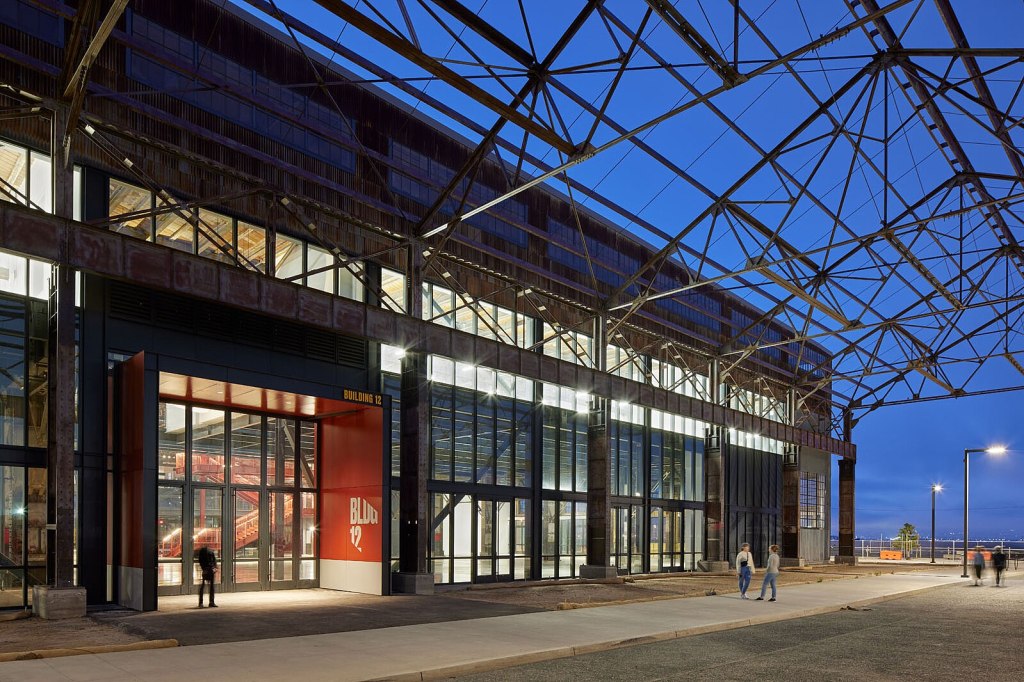
Architect – Perkins&Will
Building – Building 12
Location – Pier 70, San Francisco
Building Use – Marketplace
Area – 230000 SF
Year Built – 2022
Located in San Francisco, Building 12 is an iconic landmark that reflects the city’s industrial past while embracing a future shaped by climate resilience. Once a bustling shipyard, this 84-year old building played a crucial role in World War II, shaping San Francisco’s industrial identity. Today, it as been reimagined as a vibrant mixed-use space with retail, studios and offices. This transformation not only honors its legacy but also highlights San Francisco’s commitment to sustainability in the face of rising sea levels.
The most intriguing aspect of the project is that the building was raised by 10 ft to combat the sea level rise, keeping the structural elements and the exterior facade intact. This is not only an outstanding engineering feat, but sets a strong precedent drawing everyone’s attention to how real is the risk of rising sea levels.
Located within the Pier 70 Special Use District (SUD), Building 12 is part of a larger initiative by the Port of San Francisco and developers Brookfield Properties to raise the entire 28-Acre Pier 70 neighborhood in response to 100-year SLR projections.
By combing 100-year flood elevation with the worst-case SLR projection, Pier 70 Infrastructure Plan established a new Minimum Design Elevation (MDE) of 15.4 feet, approximately 10 feet above the original grade. This meant raising the entire 28 acre neighborhood, including its streets and newly constructed buildings.

(Source: San Francisco Port Commission, 2019, Pier 70 Infrastructure Plan, pg 20)
Since the neighborhood was largely vacant, it was relatively easy to build new streets and buildings at a higher elevation, and demolish the old ones. But for a designated historic landmark like Building 12, the challenge was far more complex as the new exterior street elevation was much higher than the existing interior level. To ensure its preservation, Pier 70 Infrastructure Plan outlined three grading options for Building 12:
- Retain the interior grade as is while raising the exterior grade.
- Raise both the interior and exterior grades, modifying windows and doors at the building’s base to accommodate the new level.
- Raise the entire structural frame to align with the new ground plane.

The design team opted for the third approach, implementing the bold move of raising of the structural frame to match the new grade. The proposed finish floor is at 22.4 ft, raised from the original 13.4 ft1, seamlessly integrating with the remaining district
The cost of elevating Building 12?
Adaptive reuse projects often results in a lower construction cost and carbon emissions2, but this may not be the case for Building 12. While raising the structure preserved its original integrity, the process was both expensive and energy-intensive. This negated many of the financial and environmental benefits typically associated with reuse.
Incidentally, had the building not been raised but instead remained at its original elevation while the exterior grade was raised (Option 1), it could have been a more cost-effective and sustainable solution. A flood mitigation strategy, such as a retaining wall or flood barriers, would have been needed to protect it from rising sea levels. Meanwhile, a thoughtfully designed landscape and infrastructure solution could have ensured accessibility between the two levels.

This approach could have significantly reduced construction costs and embodied carbon, making it a stronger precedent for sustainable adaptive reuse. As an added benefit, preserving the original building plane would have turned the structure into a living record of rising sea levels, reinforcing its relevance over time.
While cultural preservation may often drive adaptive reuse, the growing urgency of carbon-conscious design and rising construction costs make it vital to actively employ reuse as a strategy for both environmental and financial sustainability. Not every building has the luxury of extensive investment for preservation, especially those without cultural or historic significance. However, if a structure is robust and adaptable, it must be seen as an opportunity for thoughtful reuse that balances cost, carbon impact, and functionality.
- The elevations are per Fig 7.1 in the Pier 70 Infrastructure Plan, actual levels might be different ↩︎
- To learn more about how adaptive reuse can reduce carbon embodied carbon emissions, see the article Reducing Embodied Carbon: Why Adaptive Reuse Matters ↩︎




 Built Basics
Leave a comment